Digital Banking Platform Enhancement Project

⥥⥥ Executive summary ⥥⥥

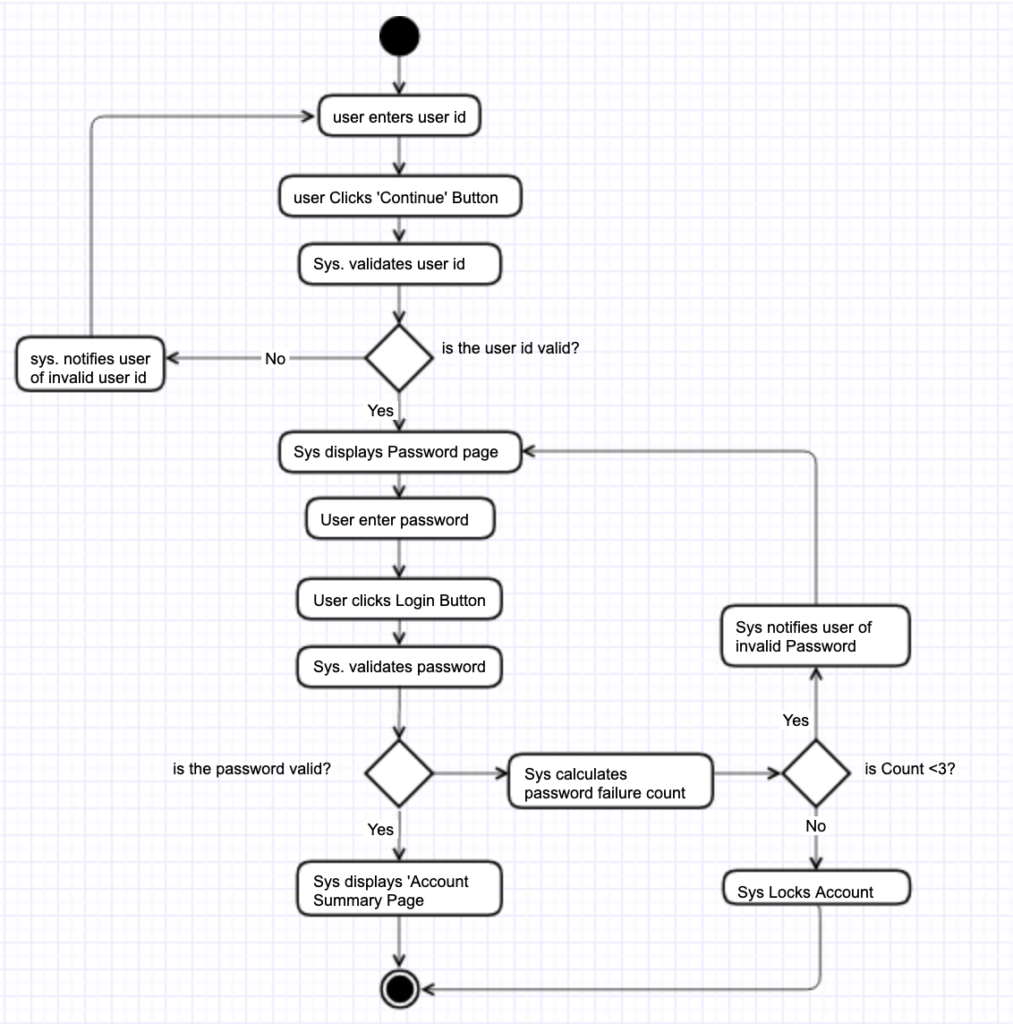
The login activity diagram defines the end-to-end authentication workflow used to validate user credentials and enforce account-security controls. The process begins with the user entering a user ID and submitting it to the system for validation. If the user ID is invalid, the system immediately notifies the user and terminates the attempt, ensuring that only recognized accounts can proceed to the password stage.

Once a valid user ID is confirmed, the system transitions the user to the password entry page. After the user submits a password, the system performs a credential check against stored authentication data. Invalid password attempts trigger a controlled failure-handling loop: the system notifies the user of the incorrect password and increments the password failure counter. If the number of failed attempts remains below the defined security threshold (three attempts), the user is allowed to retry authentication.

If the failure count reaches the threshold, the system automatically locks the account, preventing further login attempts and mitigating unauthorized access risks. A correct password immediately grants access to the user’s account summary page, completing the authentication flow.


This activity model ensures secure, structured, and auditable login behavior through sequential validation, user feedback, and automated enforcement of lockout policies.

⥥⥥ UML DIAGRAM ⥥⥥

⥥⥥ Conclusion ⥥⥥

This login activity model establishes a hardened authentication workflow that enforces deterministic validation logic, controlled error handling, and automated account-protection mechanisms. The sequential verification of user identifiers and credentials ensures that only authenticated principals progress through the access-control boundary, while the integrated failure-count subsystem provides rate-limiting and brute-force mitigation through threshold-based account locking. By codifying these operations into a repeatable process flow, the system maintains predictable authentication behavior, supports audit and compliance requirements, and strengthens the overall security posture of the application’s identity management layer.